If CHRS supplied 10% of UK home gas heat
50% of Off-Grid Oil/LPG Homes
3.4 MtCO₂/yr avoided
≈ 1.9M cars (UK) | ≈ 0.75M homes
Combined Impact (Gas + Oil/LPG)
7.76 MtCO₂/yr avoided
≈ 4.4M cars (UK) | ≈ 4.85M homes (emissions-equiv.)
Supplying 10% of GB home heat (≈23.7 TWh/yr): CHRS vs ASHP vs GSHP
Common target so you can compare like-for-like: ~2.07 million homes’ heat per year.
| Option | Units to hit 23.7 TWh/yr | Electricity needed | Typical COP | Deployment realities |
|---|---|---|---|---|
| CHRS (800 m stacks feeding district loop) | ≈ 16,500 stacks (1.44 GWh/yr each) | ≈ 7.2 TWh/yr (23.7 ÷ 3.3) | ~3.3 (stable, shallow clay source) | Invisible; trenchless HDD; centralised plant; HIU in homes; land remains usable; modular ring mains with spurs to estates, villages, cottages. |
| ASHP (individual homes) | ≈ 2.07 million units (1 per home) | ≈ 9.5 TWh/yr (23.7 ÷ 2.5) | ~2.5 (drops in cold, defrost cycles) | Outdoor units on façades/gardens; noise; visible; grid peaks in cold snaps; millions of installs/servicing visits. |
| GSHP (individual homes) | ≈ 2.07 million systems (unless built as larger plants) | ≈ 6.2 TWh/yr (23.7 ÷ 3.8) | ~3.5–4.0 (good, but site-dependent) | Deep boreholes or large trench fields per plot; high capex per home; land take; slower to retrofit at scale. |
Assumptions: Mean home heat ≈ 11,451 kWh/yr; CHRS 800 m stack ≈ 1.44 GWh/yr delivered (@COP≈3.3); illustrative seasonal COPs: ASHP≈2.5, GSHP≈3.8. Electricity figures are annual energy, not instantaneous peak power. CHRS figure represents central plant draw, typically flatter across seasons.
CHRS gives District-Scale Decarbonisation with spurs to villages and cottages – Urban and Rural in one Living Network
CHRS — 10% of GB Home Gas Heat
Utility Solar PV — 10% of UK Electricity
Wind — 10% of UK Electricity

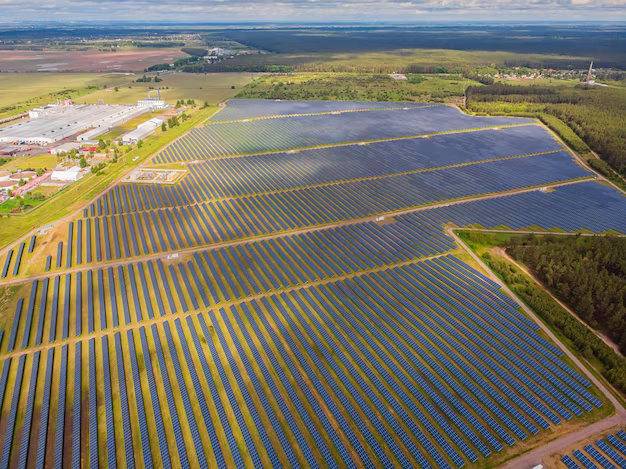

CHRS Energy – The 4th Renewable: It de-carbonises heat (where most UK emissions are), with no visible land taken.
CHRS hits the heat sector (the UK’s biggest and hardest-to-abate demand).
FUTURE HOMES STANDARD
How This Would Work
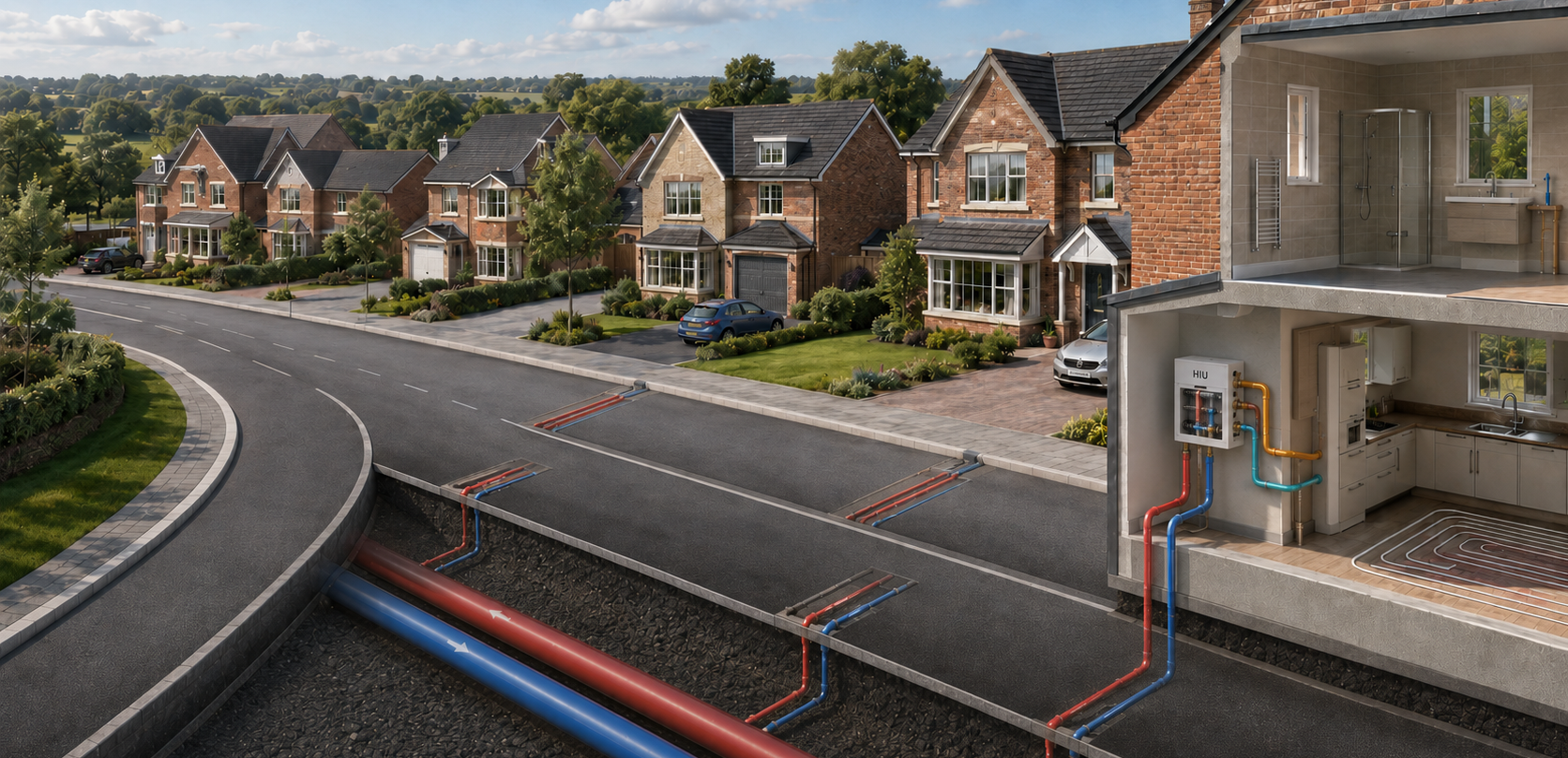
The new Future Homes Standard 2025 comes with the replacement of Combi-gas Boilers. Air Source Heat Pump’s comes with high costs, both to the Home Builder and the House Owner, along with inconsistent heat, noise and space complaints. CHRS can sort all those issues, is grant eligible, and has low OPEX costs. The Perfect Solution?
You will strip all the thermal heat from the clay and your output will drop.
No, CHRS is advanced that within each stack, the loops are split to ensure hydraulic balance, each loop is temperature monitored and each loop can be individually closed, while the remaining loops remain online to allow thermal recharge. Additionally, the system is bi-directional, meaning the heat is captured at both ends of the stack to maintain temperature uniformity.
You won’t be able to meet the demands of every household using the system at once.
Once the hot water supply ring main is up to temperature, the two heat pumps are shutdown, and one of two circulation pumps remains online to circulate the hot water around the ring main which feeds an HIU within each household. If the ring main temperature drops below a designated temperature, i.e. 65 degrees Celsius, then the CHRS opens the stack loops needed one by one to prevent thermal shock, start the heat pumps and recharge the closed-loop ring main until demand is no longer needed. This is unique, smart thermal-harvesting.
You will probably only heat 10 – 20% of the homes built.
We have stacks at lengths between 200m and 800m, each is sized for the estate, plot or site needed. Even one 200m stack can support about 58 homes with multi-decade performance of low-carbon, sustainable heating and hot water 24/7, 365-days of the year. The table below shows the direct proportional scaling of each stack.